
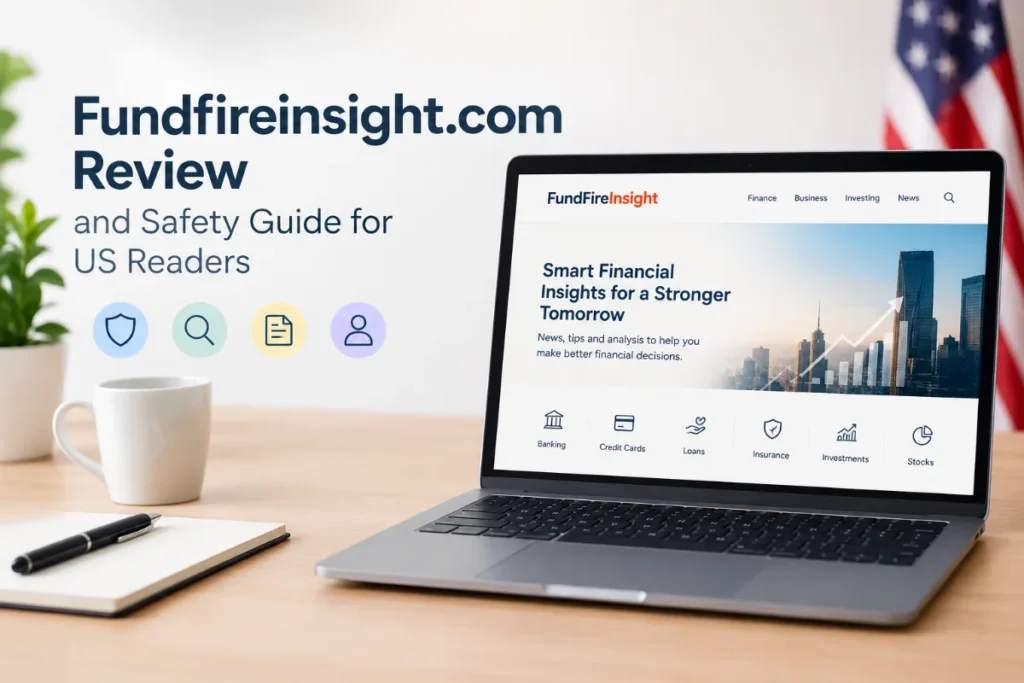
Searching for financial information online can save time, but not every website deserves the same level of trust. A professional-looking name, detailed articles, and a secure connection do not automatically prove that a financial website offers accurate information or qualified advice.
This fundfireinsight.com review examines what is publicly known about the website, the type of content associated with it, its transparency, and the important checks readers should complete before relying on its information.
FundFireInsight appears to operate primarily as a finance and business publishing website. Publicly available descriptions associate it with topics such as banking, credit cards, loans, insurance, stocks, investments, and broader financial matters. However, limited information about its ownership and editorial credentials makes it important to assess individual articles carefully. Source: Newsgiver.
One important limitation deserves attention. At the time of this review, a direct attempt to access the website returned a 403 Forbidden response. This prevented a complete first-hand inspection of its current pages. The findings below use publicly available third-party reporting and official US investor-protection resources. They distinguish reported information from details that could not be independently confirmed.
The goal is simple. You should understand what the website appears to offer, what its public information tells us, what remains uncertain, and how to protect your money and personal information while researching financial topics online.
What Is Fundfireinsight.com
Fundfireinsight.com appears to be an online publishing website that shares articles about finance and related business topics. Rather than operating like a conventional bank or brokerage, it appears to focus on written content that readers can use to learn about money, markets, and financial products.
Publicly indexed descriptions associate the website with several subject areas.
- Banking and credit cards. Articles in these categories may discuss financial accounts, payment products, borrowing costs, and everyday banking questions.
- Loans and mortgages. Readers may encounter information about borrowing, repayment obligations, interest rates, and lending options.
- Insurance. This subject can include explanations of coverage, policy terms, premiums, and common insurance questions.
- Stocks and investments. Financial publishing websites often cover market developments, investment concepts, and factors that influence asset prices.
- Business and personal finance. Related material may address business decisions, financial planning, and broader economic issues.
These topics can help readers build basic financial knowledge. However, the presence of a topic on a website does not establish the accuracy of every article within that category.
There is also an important distinction between financial education and financial services. A website can explain how a stock market works without offering brokerage accounts. It can discuss loans without being a lender. It can publish investment articles without employing licensed investment advisers.
Based on the available descriptions, FundFireInsight appears to fit the publishing category rather than a verified financial institution. Readers should confirm the specific services offered directly before providing information or making a financial commitment.

Fundfireinsight.com at a Glance
The following table summarizes the main findings from the available public information.
| Detail | Findings |
|---|---|
| Website | fundfireinsight.com |
| Apparent purpose | Finance and business publishing |
| Reported topics | Banking, credit cards, loans, insurance, stocks, and investments |
| Reported domain registration | August 18, 2023 |
| Domain registrar reported by third parties | Wild West Domains, LLC |
| HTTPS | Reported as available |
| Public ownership information | Not clearly established in the sources reviewed |
| Writer qualifications | Detailed credentials could not be confirmed |
| Verified financial institution status | Not established by the available evidence |
| Direct website inspection | Limited by a 403 Forbidden response |
| Recommended approach | Use caution and verify important claims independently |
The domain registration date and registrar information come from third-party domain reports, including ScamAdviser. The ownership and author details should be treated as unconfirmed rather than proof of misconduct.
This distinction matters because technical information and business credibility answer different questions. A domain record can show when a website was registered, but it cannot tell you if its financial analysis is accurate.
What Does the Website Offer
FundFireInsight appears to offer written information about financial and business subjects. This type of website can serve readers who want to understand unfamiliar terms, research a money-related question, or explore a topic before consulting a more authoritative source.
For example, someone comparing credit cards might first want to understand annual fees, introductory interest rates, and balance transfer costs. A person researching investments might want a basic explanation of diversification, market volatility, or the difference between stocks and bonds.
A general finance article can introduce these concepts. The reader can then use official resources and original documents to confirm the details.
However, the available evidence does not establish that FundFireInsight provides verified real-time market data, advanced portfolio analysis, personalized investment recommendations, or professional financial planning tools. Readers should not assume that such features exist simply because the website uses a finance-related name.
The most sensible way to approach its content is to evaluate each page on its own merits.
Check the publication date, identify the source of any important statistics, look for supporting documents, and consider the author’s qualifications. If an article discusses a financial product, compare its claims with the provider’s official disclosures.
This approach allows you to learn from online content without treating every published statement as established fact.
Is Fundfireinsight.com Legit or a Scam
The available evidence does not justify a definitive claim that the website is either fraudulent or fully trustworthy.
Third-party website assessment services provide some positive technical signals. ScamAdviser reports a valid SSL certificate and a domain registered in 2023. Scam Detector assigns the domain a score of 66.2 out of 100 and labels it low risk. These assessments offer useful context, but neither establishes the accuracy of the website’s articles or verifies its editorial standards.
You can review the assessments here.
It is important to understand what these reports can and cannot prove. Automated assessment services often examine technical records, domain information, and other indicators. Their scores are not government certifications, financial licenses, or guarantees against fraud.
A website may have valid HTTPS and still publish inaccurate information. A website may also have limited traffic or private domain registration without engaging in wrongdoing.
The central question is not simply whether the domain appears on a scam-checking website. It is whether the people behind the site, the information they publish, and any services they offer can be independently verified.
For now, the most balanced conclusion is that the website’s publishing purpose is reasonably clear from public descriptions, but its overall trustworthiness remains incompletely verified. Readers should use caution, especially if a page asks them to invest money, provide sensitive information, or act on a specific financial recommendation.
Who Owns Fundfireinsight.com
Ownership transparency is one of the areas that deserves closer attention.
The third-party information reviewed for this article does not clearly establish the website’s legal owner, registered operating company, or responsible editorial organization. Some reports also indicate limited public information about individual writers and their financial qualifications.
This does not automatically mean the website is unsafe. Many small publishers use privacy-protected domain registration or operate with a small editorial team.
Still, transparency matters more when a website publishes information that could influence financial decisions.
A reader should ideally be able to identify the publisher, understand who wrote an article, and find a reliable way to contact the organization responsible for the content.
Before relying on a financial article, look for the following details.
- A clear About page. It should explain the site’s purpose and identify the organization or people responsible for publishing its content.
- Author biographies. These can help readers assess a writer’s relevant experience and qualifications.
- Contact information. A working business email or another reliable contact method gives readers a way to ask questions or report errors.
- Editorial standards. A credible publisher should explain how it handles sources, corrections, sponsored content, and conflicts of interest.
- A corrections policy. Financial information changes frequently, so readers benefit from a process for fixing outdated or inaccurate claims.
I could not independently verify all these details on the live website because direct access was restricted during the review. They should therefore be treated as items to check rather than claims that every feature is absent.
Is the Website Safe for US Readers
Website safety has several parts. Technical security, privacy, content reliability, and financial risk should be considered separately.
Third-party reports indicate that fundfireinsight.com uses HTTPS. This is a positive technical sign because HTTPS helps protect information exchanged between a browser and a website from certain forms of interception.
However, HTTPS does not confirm that a publisher is honest, that an article is accurate, or that an advertised financial opportunity is legitimate.
For US readers, the most important safety questions concern the actions a website asks them to take.
If you are simply reading a general article, the immediate financial risk is usually different from the risk of sending money to an unknown person or submitting sensitive financial records. The risk increases when a website directs you to unfamiliar investment services, requests payment, or encourages you to disclose personal information.
Use these precautions.
- Avoid entering Social Security numbers, bank account details, or brokerage credentials into unfamiliar websites.
- Do not download unexpected files or install software simply because an article recommends it.
- Review the destination of external links before opening them.
- Read privacy policies and terms before submitting personal information.
- Never transfer money to a person or company solely because a website recommends it.
- Be suspicious of guaranteed investment returns or pressure to act immediately.
The US Securities and Exchange Commission warns investors about online investment scams and recommends checking the background of investment professionals before handing over money. Its official guidance is available through Investor.gov. Source: SEC investor resources.
A cautious approach is especially important when a website’s ownership, authorship, and business relationships are difficult to verify.
Does Fundfireinsight.com Provide Financial Advice
Publishing financial information is not the same as providing personalized financial advice.
A general article might explain how interest rates influence bond prices or why credit card interest can increase the cost of carrying a balance. Such explanations can help readers understand financial concepts.
Personalized advice requires a different level of care. A suitable recommendation may depend on a person’s income, savings, debts, tax situation, investment goals, time horizon, and ability to accept losses.
The available evidence does not establish that FundFireInsight is a registered investment adviser or a licensed brokerage. It should not be treated as one without further verification.
If you need professional guidance, check the qualifications of the individual and firm offering the service. The SEC’s Investment Adviser Public Disclosure database lets users research investment advisers, while FINRA’s BrokerCheck helps investors investigate brokers and brokerage firms.
You can start with these official resources.
Remember that registration checks are only one part of due diligence. You should also understand the service being offered, the fees involved, the risks you may face, and the responsibilities of the professional you hire.
A general finance website can help you prepare questions for an adviser. It should not replace a qualified professional who understands your personal circumstances.
Is Fundfireinsight.com Connected to FundFire
The similarity between the names FundFireInsight and FundFire can create confusion, particularly for readers searching for institutional investment news.
The established FundFire publication is listed by FT Specialist as a news service for professionals working in high-net-worth and institutional asset management. Its coverage includes investment trends, regulatory developments, industry appointments, and alternative asset management. Source: FT Specialist.
That publication is associated with the domain fundfire.com.
By contrast, the domain examined in this article is fundfireinsight.com. A similar name does not establish common ownership, a licensing arrangement, an editorial partnership, or any other business relationship.
I found no confirmed official evidence in the reviewed sources establishing that fundfireinsight.com is affiliated with the established FundFire publication or the Financial Times.
Readers should keep the two domains separate unless a reliable official statement confirms a connection. Check the exact spelling in the browser address bar, particularly before entering login details or responding to an offer that claims to represent a recognized financial publisher.
This is a useful precaution beyond these two websites. Similar domain names can belong to entirely unrelated organizations, so the brand name alone should never serve as proof of identity.
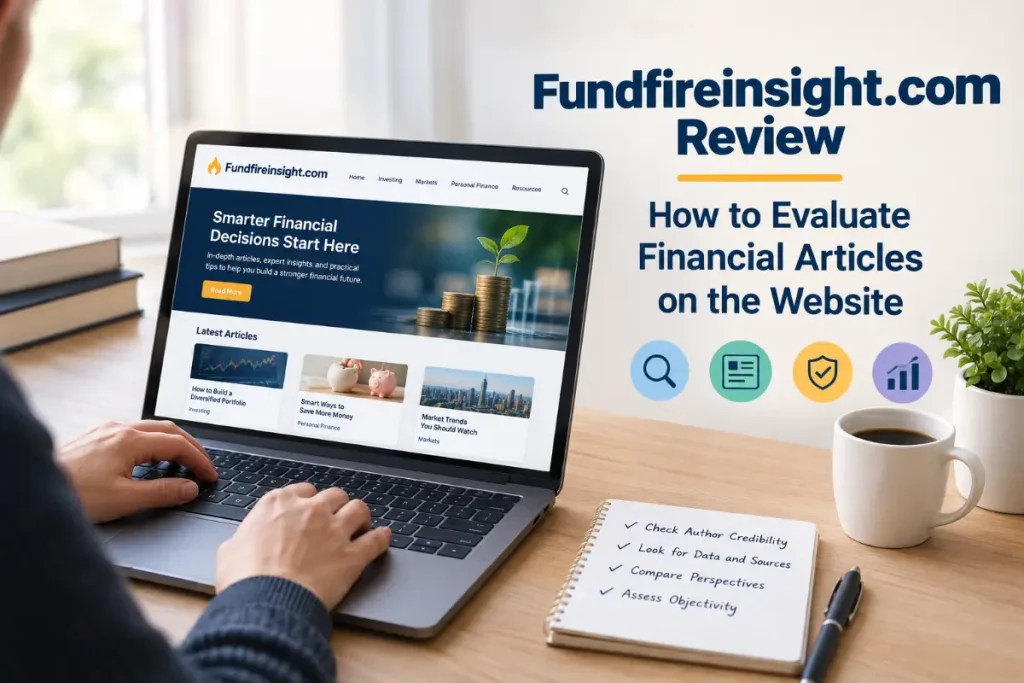
How to Evaluate Financial Articles on the Website
A practical way to assess a financial website is to review the quality of an individual article instead of relying on its design or reputation alone.
Start by identifying the article’s main claim. Is it explaining a general concept, reporting a market development, comparing financial products, or recommending a specific action? Each type of content requires a different level of evidence.
Then check the following points.
- Publication date. Interest rates, tax rules, lending conditions, and market prices can change. An older article may no longer reflect current conditions.
- Source quality. Look for links to government agencies, company filings, original research, or other primary documents.
- Author expertise. Check for relevant professional experience and qualifications rather than assuming that an impressive title proves expertise.
- Supporting evidence. Statistics and forecasts should have identifiable sources and enough context for readers to understand them.
- Balanced discussion. A useful article should explain meaningful risks and limitations, not just potential gains.
- Commercial relationships. Look for disclosures showing if the publisher may earn money from referrals, advertising, or sponsored placements.
- Clear explanations. Be cautious when an article uses complicated language without explaining the actual costs, risks, or assumptions.
- Independent confirmation. Verify important claims through sources that do not depend on the original article.
For example, suppose an article claims that a particular stock is likely to rise sharply. Do not treat that prediction as a fact. Review the company’s official financial filings, consider the assumptions behind the forecast, and research the risks of investing in that business.
The same principle applies to credit cards and loans. Compare the advertised terms with the issuer’s official disclosures, including interest rates, fees, eligibility requirements, and repayment conditions.
This method helps you separate useful background information from claims that require stronger evidence.
Advantages and Limitations
The available information suggests a few potential advantages and several limitations that readers should consider.
Potential advantages
Broad financial coverage. The site’s reported categories span banking, credit cards, loans, insurance, investments, and stocks. Readers interested in several money-related topics may find this range convenient.
An article-based format. A publishing website can introduce financial concepts without requiring users to open an account or purchase a service simply to read its material.
A starting point for research. General explanations can help readers identify unfamiliar terms and develop better questions before consulting official sources.
A domain with an established registration history. Third-party records report registration in August 2023. This provides historical context, although it does not prove reliability.
Limitations and concerns
Unclear ownership. The available sources do not clearly establish the legal entity responsible for the website.
Limited author verification. Detailed credentials for the people writing its financial content could not be confirmed from the information reviewed.
Unverified editorial standards. I could not independently establish the website’s procedures for fact-checking, correcting errors, or disclosing commercial relationships.
Limited direct access. The live website returned a 403 Forbidden response during this review, preventing a complete examination of current content and policies.
No confirmed financial licensing. The evidence reviewed does not establish the website as a regulated financial services provider.
These limitations do not prove misconduct. They do mean readers should avoid assigning the website more authority than the available evidence supports.
Better Sources for Financial Information in the United States
When a financial claim could affect your money, use sources that provide original information or have a clear public responsibility.
Here are several useful options for US readers.
| Resource | Best use |
|---|---|
| Investor.gov | Investor education, fraud prevention, and checking investment professionals |
| SEC.gov | Public company filings, securities information, and investor alerts |
| FINRA BrokerCheck | Researching brokers and brokerage firms |
| SEC Adviser Database | Checking investment adviser registration and background information |
| Consumer Financial Protection Bureau | Consumer finance topics, credit products, mortgages, and complaints |
| IRS.gov | Federal tax rules, forms, and official tax guidance |
| Federal Reserve | Monetary policy, economic data, and banking information |
These resources serve different purposes, so choose the one that matches the question you need to answer.
For instance, use the IRS for current federal tax rules rather than relying on an undated blog post. Use SEC filings to investigate a public company’s reported financial performance. Use the CFPB to learn about consumer financial products and relevant protections.
Independent sources are particularly important when an article includes a specific rate, deadline, regulatory requirement, or claim about expected investment returns.
The purpose is not to avoid every independent website. It is to confirm high-impact claims before acting on them.
Frequently Asked Questions
What is fundfireinsight.com?
It appears to be a finance and business publishing website associated with topics such as banking, credit cards, loans, insurance, stocks, and investments.
Is FundFireInsight a legitimate website?
The available evidence does not establish that it is fraudulent, but its ownership and editorial credentials remain insufficiently verified. Readers should check important claims independently.
Is fundfireinsight.com safe to visit?
Third-party reports indicate that the domain uses HTTPS. However, a secure connection does not guarantee trustworthy content. Avoid sharing sensitive information or following unverified financial offers.
Who owns FundFireInsight?
The legal owner was not clearly established in the public sources reviewed for this article. Readers should look for verifiable company information and working contact details.
Is FundFireInsight a registered financial adviser?
The reviewed evidence does not establish that the website is a registered investment adviser or brokerage. Check the relevant SEC or FINRA databases before relying on anyone offering professional investment services.
Is FundFireInsight affiliated with FundFire.com?
No confirmed official evidence reviewed for this article establishes an affiliation. FundFire.com is associated with the institutional asset management news service listed by FT Specialist.
Can I use the website for investment research?
You can consider general financial articles as a starting point, but verify investment claims through company filings, official regulators, and other reliable primary sources before making decisions.
What should I do if a financial article seems suspicious?
Stop before sending money or sharing personal information. Check the author’s identity, verify the claims through independent sources, and research any investment professional or company through official regulatory databases.
What is the safest way to verify financial information?
Use primary sources such as SEC filings, Investor.gov, IRS.gov, and the CFPB. Confirm dates, fees, rates, risks, and regulatory requirements before acting on financial information.
Final Verdict
This fundfireinsight.com review finds that the domain appears to be associated with a general finance and business publishing website. Public descriptions cover topics such as banking, credit cards, loans, insurance, stocks, and investments. Third-party reports also provide some positive technical signals, including a reported HTTPS connection.
However, important questions remain unresolved. The available sources do not clearly establish the site’s legal ownership, the qualifications of its writers, its editorial verification process, or any affiliation with a regulated financial services provider. Direct access was also restricted during this review, which limited first-hand verification.
My verdict is to treat the website as an unverified informational resource rather than an established authority for financial decisions. The evidence reviewed does not prove that the site is a scam, but it also does not support an unconditional recommendation to trust its content.
If you visit the site, evaluate each article separately. Check its date, follow its sources, verify important figures through official resources, and avoid sharing sensitive information without a clear reason.
Most importantly, never invest money based solely on an online article or an unverified recommendation. Financial decisions deserve stronger evidence than a domain name, a professional-looking page, or an automated trust score.
Our recommendation: This fundfireinsight.com review also highlights why readers should verify website security, editorial credibility, and financial claims separately before taking action.





1 thought on “Fundfireinsight.com Review and Safety Guide for US Readers”