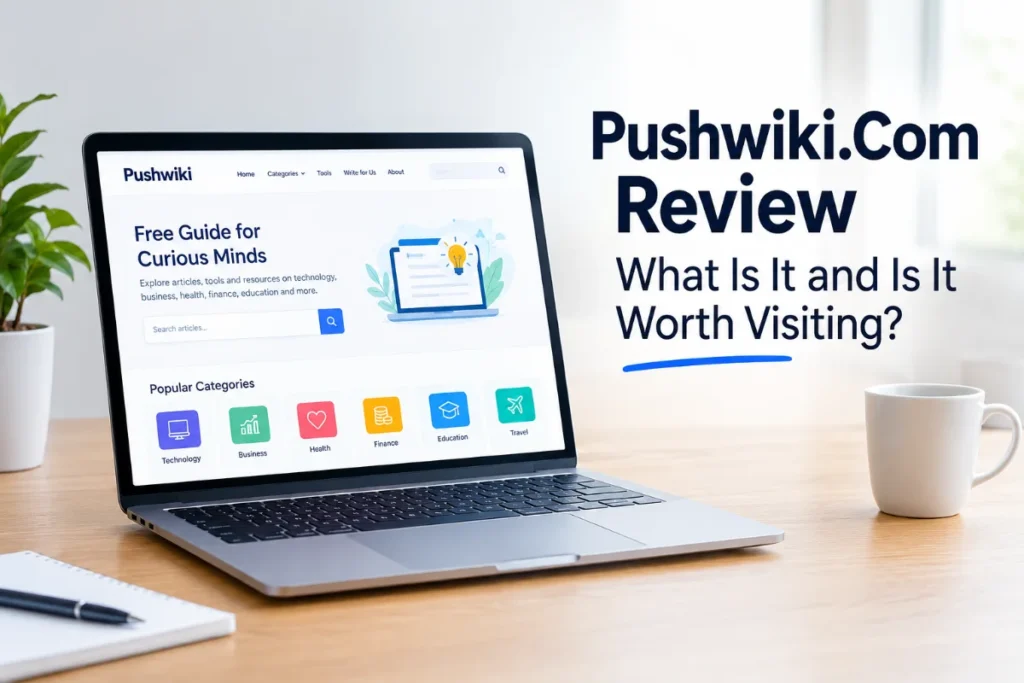
When you come across an unfamiliar website, it is natural to wonder what it offers and whether its information deserves your attention. This pushwiki.com review explores the website’s purpose, content, features, transparency, potential benefits, and limitations so you can decide how useful it might be.
The name Pushwiki may remind you of Wikipedia or another online knowledge platform. However, it is important to understand what the actual website publishes rather than judge it by its name. We will look at its publicly available information, explain what readers should check before relying on its content, and discuss how it compares with more established information sources. The goal is to give US readers a practical and balanced assessment without making unsupported promises about the website.
What Is Pushwiki.Com?
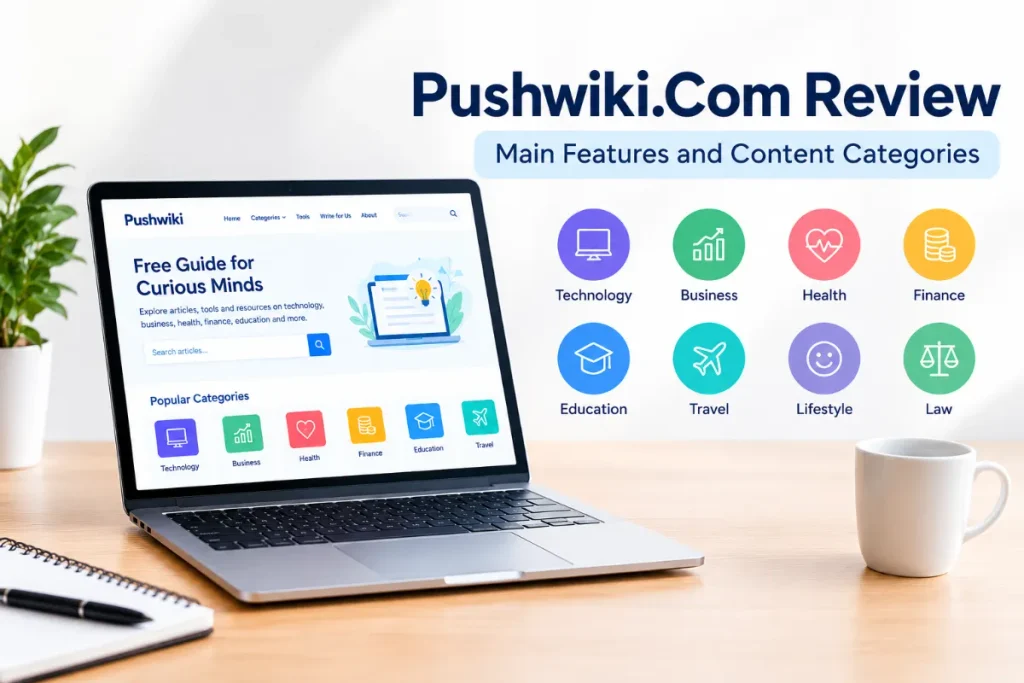
Pushwiki is an online information website that describes itself as a free guide for readers. It publishes articles covering several everyday and professional subjects, including technology, business, digital marketing, finance, health, education, law, travel, and lifestyle.
The website is designed to help people find information through organized articles rather than requiring them to search through several separate websites. Its homepage also includes a search feature, topic categories, featured articles, recently published content, and a collection of free online tools.
According to its homepage, the website had 142 English articles when it was reviewed in October 2026. The homepage also displays several content categories and recently featured stories. Pushwiki+1
Is It a Blog or a Traditional Wiki?
This is an important distinction.
A traditional wiki usually allows multiple contributors to create, edit, and improve pages. Wikipedia is a familiar example of this publishing model. Readers can explore its articles and, subject to its editing rules, participate in improving the information.
Pushwiki appears to follow a more conventional editorial publishing model. Its website presents articles under specific categories and provides information about its editorial approach. It does not clearly demonstrate an open editing system that allows ordinary visitors to change published articles.
Therefore, readers should understand it as an informational publishing website rather than assume it works exactly like Wikipedia.
The name may suggest a collaborative knowledge platform, but the actual features and publishing structure matter more than the name.
Who Is the Target Audience?
The website may appeal to several groups of readers.
- Students: People looking for introductory explanations of educational, technological, and general knowledge topics.
- Business owners: Entrepreneurs and small business operators interested in business information and digital marketing.
- Technology enthusiasts: Readers who want to explore technology news, software, AI, and online tools.
- Everyday internet users: People searching for practical answers to common questions.
- Content creators: Writers and bloggers interested in digital publishing, SEO, and free writing tools.
- General researchers: People who want an initial overview before exploring more detailed sources.
For US readers, the broad subject selection may be convenient because it brings different types of information together. However, convenience should not be confused with professional expertise. A general information website cannot automatically replace a specialist publication, official government resource, or qualified professional.
Main Features and Content Categories
The biggest attraction of a multi-topic information website is the ability to explore different subjects without constantly changing platforms. Pushwiki organizes its published material into categories and offers additional features for readers and writers.
Here is a closer look at its main offerings.
Technology
Technology is one of the prominent categories on the website. It covers subjects related to digital products, software, online services, and emerging technology.
Readers may encounter articles about AI chatbots, mobile devices, digital platforms, technology updates, and troubleshooting.
This category can be useful when you want a basic explanation of a technology-related topic. For example, someone learning about AI chatbots may benefit from an introductory article before exploring technical documentation.
However, technology changes quickly. Software features, device specifications, subscription prices, and security practices can become outdated.
Before following a technical recommendation, check the manufacturer’s website or official product documentation.
Business and Entrepreneurship
The business category covers topics that may interest entrepreneurs, professionals, and people who want to understand how companies operate.
Business-related content can help readers explore subjects such as entrepreneurship, company developments, business trends, and practical strategies.
For someone starting a small business in the United States, general articles can provide useful background information.
However, readers should not treat general business articles as personalized financial, tax, or legal guidance. Important decisions require reliable sources that reflect current US regulations and individual circumstances.
Digital Marketing
Digital marketing is another category that may interest bloggers, website owners, freelancers, and small business operators.
Topics in this area can include search engine optimization, online visibility, content creation, and digital growth.
For example, a beginner who wants to understand how search engines discover web pages may find introductory SEO material helpful.
Still, digital marketing advice needs careful evaluation. Search engine guidelines, advertising policies, and social media algorithms change frequently.
Look for articles that explain their recommendations, provide relevant examples, and link to original documentation instead of relying on broad promises about guaranteed rankings or traffic.
Finance
The finance category addresses subjects related to money and financial information.
Readers may use general finance articles to become familiar with financial terminology, understand common concepts, and explore topics before conducting more detailed research.
For US audiences, financial information deserves particular attention because federal and state rules may differ.
Always verify important information through authoritative resources such as the Internal Revenue Service, the Securities and Exchange Commission, and the Consumer Financial Protection Bureau.
A general article can help you understand a subject, but it should not determine an investment, tax, loan, or retirement decision by itself.
Health
Health information is one of the most sensitive categories on any general information website.
Readers may look for explanations of common health topics, wellness information, or general educational material.
These articles can help introduce unfamiliar terminology, but they should not replace medical advice.
If you are researching a symptom, medication, treatment, or health condition, compare the information with established medical resources such as MedlinePlus, the National Institutes of Health, and the Centers for Disease Control and Prevention.
Never change medication or delay medical care based only on an online article.
Education and Law
The education category may support readers looking for explanations of academic subjects, learning resources, and educational information.
The law category requires even more careful reading because legal requirements depend on location and circumstances.
For American readers, federal laws do not cover every legal issue. State and local rules may also apply.
For example, information about employment, housing, business registration, or consumer rights may differ between California, Texas, Florida, and New York.
Use general articles as starting points and confirm important legal details through official government websites or a licensed attorney.
Travel and Lifestyle
Travel and lifestyle content adds a more general dimension to the website.
Travel articles may help readers explore destinations, planning ideas, and practical travel questions. Lifestyle material can cover everyday interests and common activities.
These subjects can be useful for casual reading and initial research.
However, travelers should verify current entry requirements, transportation information, accommodation details, and safety guidance through official sources before making plans.
Source: Pushwiki’s publicly displayed homepage and About Us information. Pushwiki+1
Free Tools for Readers and Writers
One feature that makes the website more interesting is its collection of free online tools. These utilities are designed to help visitors complete simple writing and research tasks.
The homepage currently highlights three tools.
1. Word and Character Counter
This tool counts words, characters, sentences, and paragraphs. It also displays estimated reading and speaking times and identifies frequently used words.
2. Citation Generator
Writers can enter information about a webpage or article and generate references in APA, MLA, or Chicago style. Students and bloggers may find this helpful when preparing written work.
Date Calculator & Day Counter – Calculate Days Between Dates | Piliapp.net
3. Date Difference Calculator
This utility is intended to calculate the time between two dates. It can be useful for basic scheduling, planning, and date-related calculations.Pushwiki+2
These tools add practical value beyond ordinary articles. For example, a student preparing an assignment can use a citation generator, while a blogger can check an article’s length before publishing.
The word counter also offers a useful privacy statement. Its page says that text stays in the visitor’s browser and is not uploaded. This is a positive feature, although users should still avoid entering confidential material into unfamiliar online tools.
It is worth remembering that automated citation generators can make formatting mistakes. Always compare the final reference with your instructor’s requirements or the official style guide.
Search and Navigation Experience
A website can publish useful information but still frustrate readers if its navigation is confusing. Fortunately, Pushwiki uses a fairly straightforward category-based structure.
The homepage includes a search field that allows visitors to look for particular subjects. Readers can also browse the available categories instead of searching for individual articles.
Some useful navigation features include:
- Category browsing: Visitors can explore subjects such as technology, business, education, and finance.
- Featured content: The homepage highlights selected articles to help readers discover available information.
- Recently published material: Visitors can see articles that have been added or updated.
- Popular topics: The website highlights frequently searched subjects such as SEO, AI chatbots, investing, and health.
- Random article: This option provides another way to discover content.
- Free tools: Readers can access practical utilities through the navigation menu.
The layout appears designed for people who prefer browsing by subject. Instead of presenting every article in one long list, the website separates its content into recognizable sections.
However, a good navigation system does not automatically mean that every article is accurate or comprehensive. Readers should evaluate the quality of the actual information rather than judge a website entirely by its appearance.
Newsletter and Contributor Opportunities
The website also displays a newsletter subscription option. According to its homepage, subscribers can receive a weekly selection of articles about business, technology, health, money, and other subjects.
This may be convenient for readers who prefer discovering new content through email instead of repeatedly checking a website.
The homepage also provides a Write for Us section and an advertising option. These features suggest that the website has pathways for potential contributors and commercial partnerships.
However, the existence of a contributor page does not establish the quality of every submitted article. Before submitting original work, check the contribution requirements, editorial expectations, publication terms, and any applicable fees.
Likewise, businesses considering an advertising opportunity should ask about audience demographics, website traffic, placement details, sponsored content labeling, and performance reporting.
Is Pushwiki.Com Legit and Safe to Use?
This is probably the most important question for someone discovering an unfamiliar website.
The available evidence suggests that pushwiki.com is a functioning informational publishing website with publicly accessible articles, category pages, tools, and policy pages. Its homepage identifies its purpose, and visitors can browse its content without being directed to a paid membership as a condition of reading.
However, being a functioning website is not the same as proving that every published claim is reliable or that every interaction is risk-free.
A sensible assessment should consider several factors.
Website Transparency
The website provides About Us, Contact Us, Editorial Policy, Privacy Policy, Terms and Conditions, and Disclaimer links.
Having these pages is a positive starting point because visitors can look for information about the website’s purpose, editorial practices, and policies.
However, closer inspection reveals some transparency concerns.
The About Us page currently contains placeholder wording in its description of who runs the website. It says that Pushwiki is run by a placeholder name and experience statement rather than providing a completed identity.
The Contact Us page also displays placeholder wording where a contact email should appear.
Similarly, the Editorial Policy includes an unfinished placeholder in its research section, asking the publisher to describe how it researches and tests its content. Pushwiki+2
These are meaningful weaknesses.
Readers deserve to know who is responsible for publishing information, especially when the website covers health, financial, and legal subjects.
This does not establish that the website is fraudulent. It simply means that its public-facing transparency needs improvement.
Editorial Standards and Fact Checking
Pushwiki states that it checks information against original sources, links to those sources, and updates articles when information changes.
Its editorial policy also says that advertisers do not approve stories before publication and that sponsored content should be labeled. Pushwiki+1
These are positive editorial principles.
However, the research section of the published policy is incomplete. This makes it difficult for an outside reader to understand exactly how articles are researched, tested, reviewed, or fact-checked.
For a stronger editorial standard, readers should be able to identify:
- The person responsible for an article.
- The sources used to support important claims.
- The original publication or update date.
- The process for correcting inaccurate information.
- Any relevant financial relationships or sponsored content.
- The qualifications of contributors covering specialized subjects.
Until these details are consistently available, readers should independently verify important claims.
Basic Website Security
Before using any unfamiliar website, check its address carefully and make sure the connection uses HTTPS.
An HTTPS connection helps protect information transferred between your browser and the website. However, it does not prove that the publisher is trustworthy or that its articles are accurate.
You should also pay attention to unexpected downloads, suspicious redirects, misleading advertisements, and requests for unnecessary personal information.
For ordinary reading, there is generally no reason to provide sensitive information.
If you decide to subscribe to the newsletter, review the privacy policy and understand how your email address may be used. Avoid sharing financial details, passwords, identification documents, or other confidential information without a clear and legitimate reason.
What About Independent Trust Reports?
Third-party website reputation services can provide another perspective. For example, ScamAdviser has published a report on pushwiki.com that mentions a valid SSL certificate and a domain registered in 2023. It also identifies concerns such as hidden WHOIS ownership and relatively low website traffic. Scamadviser
These signals should be interpreted carefully.
A hidden domain registration does not automatically indicate a scam. Many legitimate website owners use privacy services to protect their personal information.
Likewise, low traffic does not prove that a website is unsafe. Smaller publications may have limited audiences while still providing useful information.
The best approach is to combine technical checks, publisher transparency, content quality, and independent verification rather than rely on one trust score.
Practical verdict Pushwiki appears suitable for cautious browsing and general information discovery. Its incomplete publisher and editorial details mean readers should not treat it as a fully verified authority.
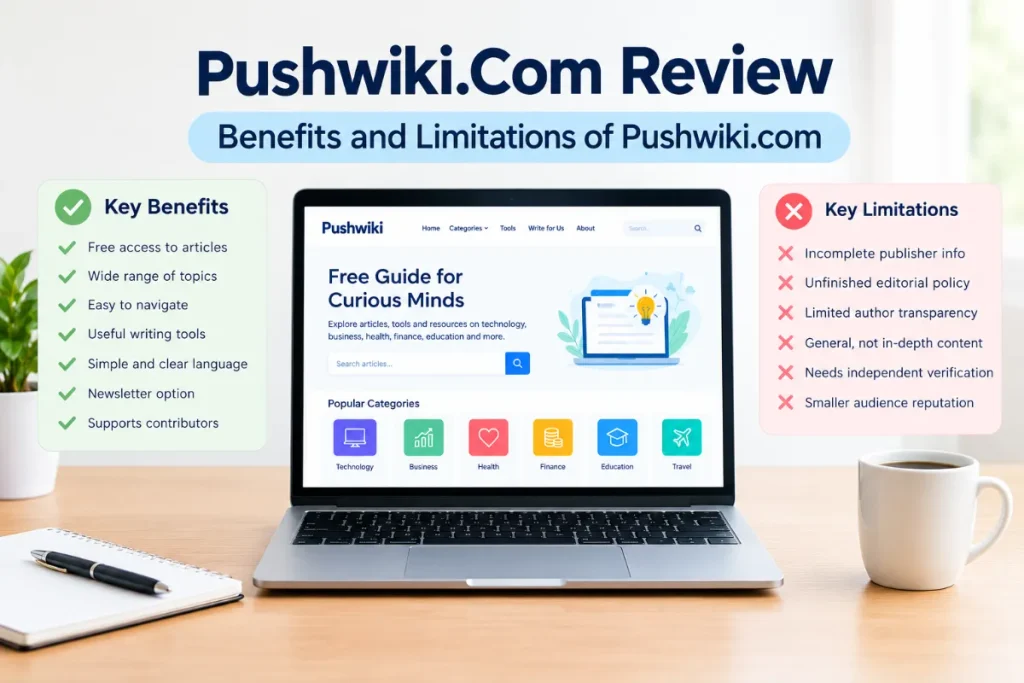
Benefits and Limitations of Pushwiki.com
Every website has strengths and weaknesses. A fair review should consider both instead of presenting every feature as a reason to trust a platform.
Here are the main advantages and limitations based on the publicly visible website.
Main Advantages
- Free access to articles: Readers can explore the website’s published information without an advertised reading subscription.
- Multiple subject categories: The website brings together technology, business, finance, education, health, and other topics.
- Simple navigation: Category menus and search options make it easier to discover relevant articles.
- Useful writing utilities: The word counter and citation generator offer practical assistance to writers and students.
- Plain English approach: Its stated publishing goal focuses on making information accessible to general readers.
- Editorial and policy pages: The website provides several pages explaining its purpose, policies, and publishing principles.
- Newsletter option: Interested readers can subscribe to receive selected articles through email.
Main Limitations
- Incomplete publisher information: The About Us page does not currently provide a completed name and experience statement.
- Unfinished editorial details: Its research policy contains placeholder wording rather than a complete explanation of its fact-checking process.
- Limited author transparency: Readers may find it difficult to establish the qualifications and experience behind individual articles.
- Broad subject coverage: A website covering many subjects may not offer the depth of a specialist publication.
- Independent verification is necessary: Readers should check important information against original and authoritative sources.
- Limited evidence of audience reputation: The available information does not establish a substantial record of independent reader feedback.
Quick Comparison
| Evaluation area | Assessment |
|---|---|
| Reading access | Free |
| Content variety | Broad |
| Navigation | Category based |
| Writing tools | Available |
| Publisher transparency | Needs improvement |
| Editorial policy | Published but incomplete |
| Professional advice | Not a substitute |
| Best use | General information discovery |
The main takeaway is that the website offers several useful features, but its editorial transparency needs more work before readers can confidently rely on it for important decisions.
How to Evaluate Pushwiki Before Using It
If you are planning to use an unfamiliar information website regularly, a few simple checks can help you make better decisions.
These steps are especially important for US readers researching health, finance, technology, and legal topics.
1. Check the Exact Website Address
Start by confirming that you are visiting the intended domain.
The official address discussed in this article is:https://pushwiki.com/
Do not assume that websites with similar names, additional hyphens, or different domain extensions have the same owners.
A small spelling difference can take you to an entirely different website. Always check the address bar before entering information or following recommendations.
2. Read the About and Contact Pages
Look for a clear explanation of who operates the website and how readers can reach the publisher.
Check whether the About page identifies the editorial team, provides meaningful professional backgrounds, and explains the website’s purpose.
In this case, the unfinished publisher information is worth considering before placing significant trust in the content.
3. Examine Article Sources
Open an article and look for links supporting its major claims.
Reliable informational writing should make it reasonably easy to trace important facts to their original sources.
For example, a financial article discussing US tax rules should ideally link to relevant IRS information. A health article should reference recognized medical sources when discussing treatments or medical recommendations.
If an article makes important claims without evidence, do additional research.
4. Check Publication and Update Dates
An article can be accurate when published but become outdated later.
This is particularly important for:
- Artificial intelligence and software.
- Financial regulations and tax rules.
- Medical guidance.
- Government policies.
- Travel requirements.
- Product prices and specifications.
Always look for the publication date and the most recent update date. Then compare important details with current official information.
5. Protect Your Personal Information
You should not need to provide unnecessary personal details simply to read an informational article.
Before subscribing, submitting a contact form, or using an online tool, understand what information the website requests and why.
Use strong, unique passwords when creating accounts on websites that require registration. Avoid sharing sensitive information through ordinary contact forms.
6. Compare Important Information With Trusted Sources
Never depend on a single general information website when making a decision that could affect your health, finances, legal rights, or personal security.
For US readers, useful independent resources include:
- USA.gov for official government information.
- Internal Revenue Service for federal tax information.
- Consumer Financial Protection Bureau for consumer financial guidance.
- MedlinePlus for reliable health information.
- Federal Trade Commission for consumer protection and online safety information.
These resources provide more authoritative information for their respective areas.
Final Verdict: Is Pushwiki Worth Your Time?
After examining its publicly available pages, categories, tools, and editorial information, Pushwiki appears to be a general information website designed for readers who want accessible articles across different subjects.
Its biggest strengths are its broad content selection, straightforward navigation, free reading access, and additional writing utilities. These features may make it useful for students, bloggers, professionals, and everyday internet users.
However, there are some important weaknesses.
The incomplete About Us information, placeholder contact email, and unfinished research policy make it difficult to independently assess the people and processes behind the website. These issues deserve attention, particularly because the platform publishes content about health, finance, and law.
So, is pushwiki.com review positive or negative?
My assessment is mixed but cautiously positive for general browsing.
The website may be worth exploring if you want introductory information or simple online tools. However, I would not recommend treating it as your only source for important research, professional advice, or financial decisions.
The best approach is to explore its articles, evaluate their sources, and compare important claims with established publications and official resources.
Ultimately, a website earns trust through accurate information, transparent authorship, consistent editorial standards, and accountability. Improving these areas would make Pushwiki a more convincing information resource.
Frequently Asked Questions
What is Pushwiki mainly used for?
Pushwiki is an informational website that publishes articles about technology, business, digital marketing, finance, health, education, law, travel, and lifestyle. It also offers free tools for readers and writers.
Is Pushwiki free to use?
Yes. Its publicly accessible articles and listed online tools are available without an advertised subscription requirement for ordinary browsing. Newsletter subscriptions are optional.
Is Pushwiki a legitimate website?
Pushwiki is a functioning informational website with published articles, contact and policy pages, and online utilities. However, its incomplete publisher information and editorial policy mean readers should independently evaluate its credibility.
Is Pushwiki the same as Wikipedia?
No. Wikipedia is a collaborative encyclopedia where contributors can edit articles under established community rules. Pushwiki appears to operate as a conventional editorial publishing website rather than an openly editable encyclopedia.
Can I trust the information published on Pushwiki?
You can use its articles for general reading and introductory research. However, verify important claims through original sources, government websites, recognized medical publications, or qualified professionals.
Does Pushwiki offer tools for writers?
Yes. Its homepage lists a word and character counter, a citation generator, and a date difference calculator. These tools can help with basic writing, referencing, and planning tasks.
Should I use Pushwiki for professional research?
It can be a starting point for discovering a subject, but it should not replace academic journals, official documentation, specialist publications, or primary research sources.